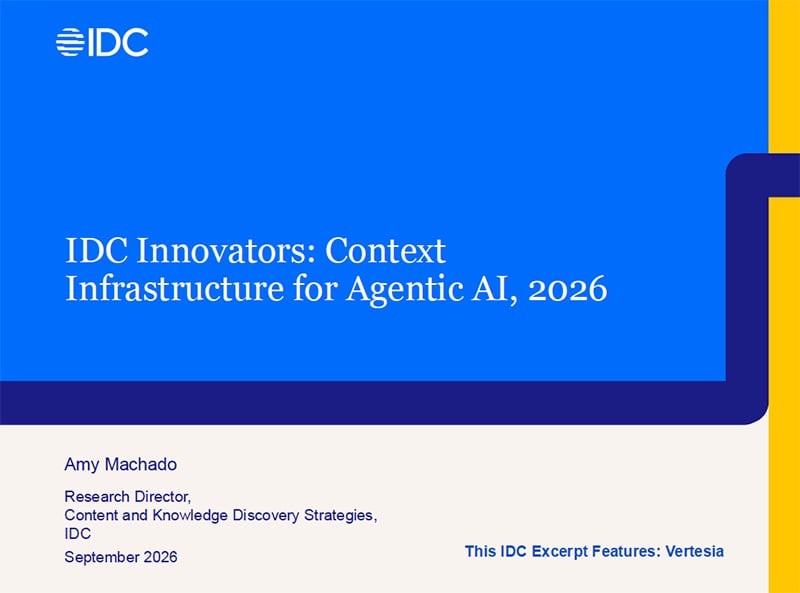


CONTEXT INFRASTRUCTURE FOR AGENTIC AI

IDC Innovators: Context Infrastructure for Agentic AI, 2026

This 2026 IDC Innovators study introduces context infrastructure for agentic AI, an important trend built on a single premise: The reliability of an agent depends on the context it reasons over, not just the model behind it.

IDC Innovators: Context Infrastructure for Agentic AI
EXECUTIVE SUMMARY

The constraint on enterprise AI today is context, not model capability.

Agents can already reason quickly and fluently, but a fluent answer built on the wrong information is still wrong. A large volume of enterprise content was never built to be machine readable, governed, or traceable back to a source. Context infrastructure for agentic AI is an emerging category responding to that gap, with the tooling that makes institutional knowledge and context accessible, permissioned, and verifiable enough for agents to actually use.

This segment views context as the foundational element that an agent uses for reasoning. It emphasizes content that is structured, chunked, and semantically tagged so its meaning survives machine processing rather than being flattened or lost. The focus is on knowledge that is both reliable and verifiable, along with discovery aligned to true intent and transparency, regarding how an organization's knowledge and brand are represented when an AI system interprets them.

Vendors here approach the challenge from various angles, ranging from building accurate domain-focused search to developing and deploying AI-native applications. Trust is emerging as a critical factor in determining which agent-based AI implementations succeed in real-world applications rather than just in demonstrations.

DOWNLOAD THE EXCERPT
IDC Innovators: Context Infrastructure for Agentic AI, 2026
  • amy-machado-idc

"Model capability is no longer the bottleneck for AI and agentic AI. The vendors that win enterprise trust will be the ones that can prove how they prepare, ground, and govern the context an agent depends on."

Amy Machado
Research Director at IDC

CONTEXT INFRASTRUCTURE FOR AGENTIC AI

Why Vertesia was chosen as an IDC Innovator in this report

AI-native content services

Unlike most of the market, its leadership team (several of them veterans of Nuxeo) built an agentic platform first, prioritizing durability, orchestration, and governance, then worked backward into a stateless, serverless content layer, since agents depend on context drawn from content structure. The result is a platform built natively for AI and agentic workflows, where legacy content solutions must retrofit or bolt on.

Intelligent context layer
Vertesia's context layer

Vertesia's context layer combines document preparation with governance, auditing, and guardrails for trusted agent behavior at scale. Semantic DocPrep helps AI find context by converting complex documents into enriched, semantically tagged XML or markdown, without rewriting or altering the source content. By preserving the original structure and relationships within a document, it gives LLMs a richer context to reason over.

Cloud-agnostic architecture

Vertesia's cloud-agnostic architecture helps regulated industries meet data residency needs without infrastructure lock-in. Combined with model-agnostic support across 100+ AI providers, this reinforces a consistent "no lock-in" stance against competitors tied to a single cloud or narrow model partnerships.

WHY READ THIS EXCERPT?

Learn how Vertesia delivers context infrastructure for agentic AI

Vertesia delivers context infrastructure for agentic AI through its context layer and Semantic DocPrep, which preserves a document's structure and meaning while converting it into agent-ready, source-traceable content.

This IDC Innovator report provides an assessment of the following Vertesia capabilities:

  1. Content architecture for agentic AI
  2. Intelligent context layer
  3. Migration and modernization approach

Learn what makes Vertesia an IDC Innovator by exploring Vertesia's key differentiators which include:

  • Agent-first architecture for content management
  • MCP-native integration removes connector maintenance
  • Migration economics at scale
DOWNLOAD THE EXCERPT
The IDC Innovators: Context Infrastructure for Agentic AI, 2026

The content for this excerpt was taken directly from “IDC Innovators: Context Infrastructure for Agentic AI, 2026” (September 2026, Doc #US54899426)

FAQS

Questions about context infrastructure for agentic AI

What is IDC's definition of context infrastructure?

IDC defines context infrastructure as the set of technologies, including knowledge graph engines, intelligent search platforms, neural-symbolic reasoning, semantic document preparation, and analytics services, that transform fragmented enterprise data into structured, retrievable context. Context infrastructure is what an AI agent depends on to reason accurately, act autonomously, and produce answers grounded in real, governed enterprise knowledge rather than a model's general training data alone.

What is IDC's definition of agentic AI?

IDC defines agentic AI as AI systems capable of autonomous, multistep action on a user's or organization's behalf, going beyond single-turn question answering to plan, retrieve, reason, and execute tasks with limited human intervention. Agentic AI's reliability depends directly on the quality of the context infrastructure feeding it; an agent reasoning over ungoverned or poorly structured content will act autonomously on wrong information just as confidently as on correct information.

An IDC Innovators report presents a set of vendors – under $100M in annual revenue at the time of selection – chosen by an IDC analyst within a specific market that offer a new technology, a groundbreaking solution to an existing issue, and/or an innovative business model. It is not an exhaustive evaluation or a comparative ranking of all companies, but rather a document that highlights innovative companies in a specific market segment. IDC INNOVATOR and IDC INNOVATORS are trademarks of International Data Group, Inc."