
Design
Create content types, prompts, processes, agents, and skills in one workspace.

Test
Run changes against real data before they reach production.

Promote
Move approved versions from draft to staging to production, with full auditability.
Iterate
Watch how things behave in production. Continuously improve in the same workspace.

Build the way work actually flows.
Most companies use one tool for prompts, another for processes, and a third for content types. The pieces never quite line up. Studio puts everything in one workspace: content types, prompts, processes, skills, and agents. Every change inherits the same governance model as the rest of the platform.

From idea to running agent in minutes.
Our AI Studio Assistant is built into every part of Studio. Describe what you want in plain language and the assistant builds it. Upload a whiteboard photo and it turns into a process. Import a BPMN diagram and it maps into Vertesia. Every draft is checked against governance rules. Most teams have a working agent up and running in a few minutes.

Build fast. Promote safely. Audit easily.
Test prompts against different models side by side, comparing quality, speed, and cost. Run processes against real data. Pin the versions that work. Roll back anything that does not. Every change is versioned and audited. Product teams iterate on prompts without filing tickets. Process owners tune workflows as teams learn. Developers lock down what runs in production.

Structured inputs and outputs
Define exactly what data the Interaction needs and what format it returns. Outputs can be plain text or structured JSON, validated automatically so downstream systems always get clean data.

Prompt library
Prompts are saved as reusable templates. Use variables to make them work for any document or data set. Fork an existing prompt, adjust it for a new use case, and reuse it in a new Interaction without starting from scratch.

Playground
Test any Interaction with real data before it goes anywhere near production. The Playground shows you exactly what the AI returns, so you can tune the prompt and the output schema until the results are right.




Any AI model
Connect to OpenAI, Google Enterprise Agent Platform, Amazon Bedrock, Microsoft Foundry, and more. One workspace, every major model on the market, including your own private models.
Load balancing and failover
Distribute requests across multiple models for performance or cost optimization. Set a backup model to take over automatically if a primary model goes down.

Model comparison
Run the same Interaction against multiple models side by side. See which model gives the best results for your specific use case before you commit.
Fine-tune private models
Continuously fine-tune private models with built-in testing and comparison, deployable in your Cloud or VPC for full security and control.

Agent builder
Combine Interactions with built-in tools to create an AI agent. The agent uses a large language model as its reasoning engine. It reads, decides, acts, and reports back autonomously.

Tools and skills
Agents come with a library of built-in tools: web search, document retrieval, parallel workstreams, and more. Tools are what agents use to interact with the outside world.

Durable agent execution
Vertesia agents do not time out on long tasks. State is preserved if a system restarts. An agent waiting for an external system picks up exactly where it left off.
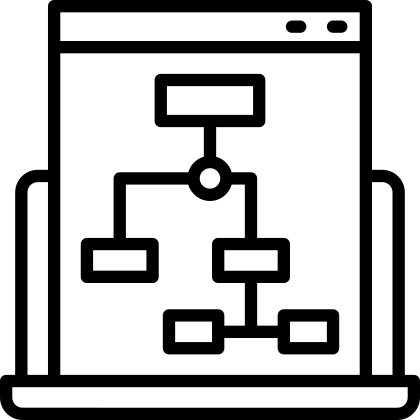
Process designer
Design multi-step workflows as a visual graph of nodes and transitions. Each node can be an AI task, an automated tool, a human approval step, or a branching condition.

Human checkpoints
Pause a process and route work to a specific person for review. The workflow waits without wasting compute, then picks back up when the person submits their response.

BPMN import
Already have process diagrams? Import them. Studio converts supported BPMN patterns automatically and flags anything it cannot convert clearly, without silent failures.
REST API
Execute interactions, trigger agents, and manage processes programmatically. Every Studio-built capability is available via a documented, versioned REST API.

JavaScript SDK
Integrate Vertesia interactions and agents directly into your JavaScript or TypeScript applications. The SDK handles authentication, execution, and result handling.

OpenAPI / Swagger
A full OpenAPI specification describes every endpoint. Import it into your API tooling or generate a client in your language of choice.

Model Context Protocol (MCP)
Expose Studio-built capabilities to external agents and tools via MCP. Connect to Microsoft, Google, GitHub, Atlassian, Notion, and more, in both directions.