NEWS
Redefining the Agentic AI Life Cycle: Vertesia Named an IDC Innovator
Vertesia named an IDC Innovator for transforming enterprise AI with document-first intelligence and low-code empowerment.
Agentic AI transforms marketing analytics with natural language queries, automated data integration, and interactive dashboards for post-campaign insights.
It’s 3 PM on a Monday, and your CMO wants to know which creative variations drove the highest conversion rates in last month’s multi-channel campaign. You know the data exists—scattered across Google Ads, Facebook Ads Manager, your CRM, and several Excel files your media agency sent over. What should be a simple question turns into a multi-day odyssey: export data from five platforms, clean and normalize it in spreadsheets, build pivot tables, create charts in PowerPoint, and hope you didn’t miss anything critical.
Sound familiar? For marketing and advertising teams, post-campaign analytics has become a bottleneck that slows decision-making and limits creative optimization. But a new approach—agentic database management powered by AI—is changing everything.
Modern marketing campaigns generate enormous volumes of data across fragmented platforms. A typical campaign might span paid search, social media, display advertising, email, and offline channels, each with its own reporting interface and data format. Measuring creative effectiveness and media performance requires combining this disparate data, but traditional solutions fall short:
Tool proliferation creates complexity: Many organizations deploy separate platforms for data warehousing (Snowflake, BigQuery), business intelligence (Tableau, Looker, Power BI), and data transformation (dbt, custom ETL scripts). Each tool requires specialized skills, licensing costs, and maintenance overhead. Marketing teams either become dependent on data analysts for every question or struggle with tools designed for technical users.
Technical barriers limit agility: Getting answers requires SQL knowledge, understanding database schemas, and navigating complex BI interfaces. When marketing teams need to measure creative effectiveness or calculate multi-touch attribution, they submit tickets and wait days—or weeks—for data teams to deliver reports. By the time insights arrive, campaign momentum has stalled.
Fragmented workflows waste time: The typical analytics workflow involves downloading data, reformatting files, importing to analysis tools, building visualizations, and manually updating reports. This manual process is error-prone, time-consuming, and impossible to scale when you’re running dozens of campaigns simultaneously.
What if you could simply ask, “Which ad creatives had the highest return on ad spend last month?” and receive a comprehensive analysis with interactive dashboards in minutes—without writing a single line of SQL or touching a BI tool?
Vertesia’s agentic database management platform makes this possible by combining three breakthrough capabilities: AI agents that understand natural language requests, an integrated analytics database (powered by DuckDB), and automatic visualization generation (using Vega-Lite). Instead of juggling multiple tools, marketing teams work with AI agents that handle the entire analytics workflow autonomously.
The platform transforms marketing analytics through an agent-driven workflow that eliminates technical barriers:
Intelligent data integration: Upload campaign data files (CSV, Excel, JSON) or connect to existing data sources. AI agents automatically analyze the data structure, infer appropriate schemas, and create optimized database tables. No manual schema design or data modeling required—the agent understands that your “campaign_performance.csv” contains metrics like impressions, clicks, conversions, and spend.
Natural language to SQL: Ask questions in plain English: “Show me conversion rates by creative type and audience segment” or “Compare email campaign ROI across customer cohorts.” The AI agent translates your question into sophisticated SQL queries, including complex operations like window functions for attribution analysis, joins across multiple tables, and statistical aggregations. You get the insights without learning SQL syntax.
Automatic visualization: Agents don’t just return raw data—they generate interactive dashboards tailored to your question. A query about creative effectiveness might produce a scatter plot showing click-through rate versus conversion rate by creative, a bar chart of top-performing assets by ROAS, and a time-series view of performance trends. Dashboards support cross-filtering, so clicking on a creative automatically updates all panels to show detailed metrics.
Version control for data: Every data import and schema change is automatically versioned, creating a complete audit trail. Compare this week’s campaign performance to last week’s snapshot, roll back to previous data states, or analyze how metrics evolved over time. This versioning is critical for compliance, debugging data quality issues, and conducting rigorous A/B test analysis.
Vertesia’s agentic approach solves the most pressing marketing analytics challenges:
Campaign performance analysis: Import data from all your advertising platforms into a unified database. Ask the agent, “Which campaigns underperformed last month?” and receive an analysis showing performance trends by channel, conversion funnel visualization, and ROI comparisons—complete with recommendations for budget reallocation. Real-time monitoring dashboards update automatically as new data arrives, alerting you when campaigns deviate from expected performance.
Creative effectiveness measurement: Understanding which ad creatives drive results is crucial for optimization but notoriously difficult to measure across channels. Upload creative performance data and ask, “Which video ads had the highest engagement rate among millennials?” The agent calculates engagement metrics, segments by audience demographics, and generates visualizations comparing creative variations. You can drill down from high-level summaries to individual asset performance with interactive filtering.
Multi-channel attribution: Modern customer journeys span multiple touchpoints before conversion. Traditional last-click attribution misses the full picture, but multi-touch attribution requires complex analysis. Vertesia agents use SQL window functions to calculate attribution weights across the customer journey, comparing first-touch, last-touch, and linear attribution models. Interactive dashboards visualize how each channel contributes to conversions, helping you optimize media mix and budget allocation.
Audience segmentation and cohort analysis: Import customer data alongside campaign metrics to analyze which acquisition sources deliver the highest lifetime value. The agent segments customers by channel, demographics, and behavior, then calculates retention curves, LTV by segment, and engagement trends. You might discover that email-acquired customers have 23% higher LTV than paid social—actionable insights that inform targeting strategy.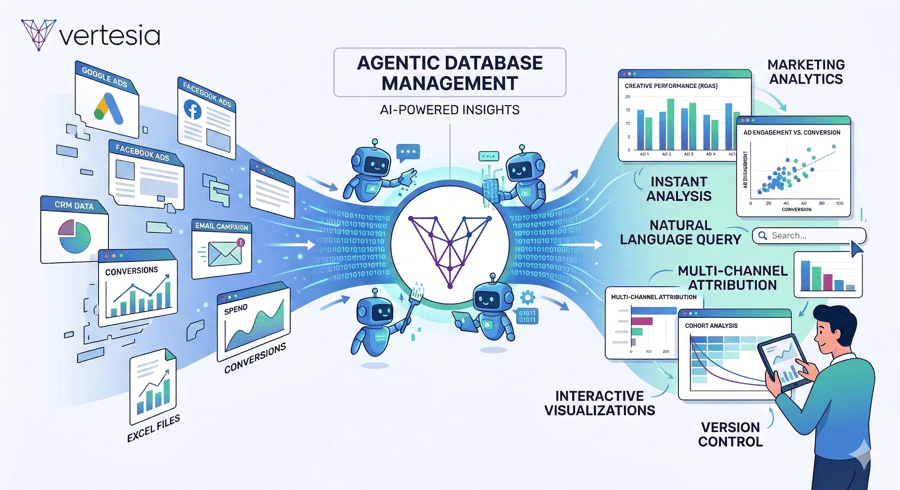
The benefits extend far beyond technical capabilities:
Marketing teams achieve time-to-insight in minutes instead of days, enabling rapid campaign optimization while budgets are still active. Self-service analytics empowers marketers to answer their own questions without depending on data teams, dramatically increasing analytical capacity.
Organizations reduce costs by eliminating separate BI platforms, data warehouses, and ETL tools. Vertesia provides an integrated solution without per-seat licensing fees or infrastructure overhead. One marketing director reported saving $200,000 annually in BI licensing and data engineering costs.
Most importantly, agentic analytics democratizes data access. Marketing coordinators can perform sophisticated attribution analysis. Campaign managers can measure creative effectiveness. CMOs can explore data interactively during strategy meetings—all without technical training.
The shift from traditional BI tools to agentic database management represents a fundamental change in how organizations approach analytics. Rather than forcing business users to learn technical tools, AI agents meet users where they are—speaking natural language and delivering insights in intuitive formats.
For marketing and advertising teams drowning in data but starving for insights, this transformation couldn’t come soon enough. Post-campaign analytics shifts from a bottleneck to a competitive advantage. Creative optimization happens in real-time rather than after budgets are spent. Attribution analysis becomes accessible rather than requiring data science expertise.
The question isn’t whether AI will transform marketing analytics—it’s whether your organization will lead or follow. The tools to revolutionize your approach are available today.
Ready to transform your marketing analytics? Discover how Vertesia’s agentic platform can eliminate analytics bottlenecks and accelerate your time to insight. Schedule a demo to see agentic database management in action with your own campaign data.
Vertesia named an IDC Innovator for transforming enterprise AI with document-first intelligence and low-code empowerment.
Discover how Vertesia serves as the intelligence layer for your company, connecting existing systems and enhancing workflows.
Imagine a global council of experts debating UBI in Finnish, Hindi, Japanese, and Arabic. Our AI experiment brings authentic cultural reasoning.