

CONTENT INTELLIGENCE

Semantic content preparation and retrieval for AI agents

Vertesia’s AI-powered content preparation and retrieval system provides content intelligence for AI agents. It transforms documents, media, and records into structured, searchable, permission-aware knowledge so people and agents can find grounded answers, verify sources, and identify patterns across large content collections.

Prepare your content for AI
THE CHALLENGE

Turning enterprise content into governed intelligence

80% of enterprise data is unstructured. Raw PDFs, scanned forms, and siloed files lose their structure when fed to AI. Tables break. Context disappears. The right document stays hidden. Without proper preparation, your AI fills the gaps with wrong answers.

wrong-answer
AI hallucinates without context

Raw documents lose structure without proper preparation. Tables break. Clauses, terms, and conditions get separated. Agents guess and produce inaccurate results.

search-data
Findability is a big challenge

Enterprise content is buried across silos. Knowledge workers spend 30-40% of their time searching for information they know exists. AI agents face the same friction without proper indexing.
collections
Knowledge is locked away

Years of institutional knowledge is trapped in content repositories containing past reports, prior analyses, historical decisions, etc. Without AI-ready indexing, important insights and answers remain locked away.

THE SOLUTION

AI-powered content intelligence

Content intelligence is a content preparation and retrieval system built for AI agents. It turns raw enterprise content into structured, searchable knowledge, prepared, enriched, indexed, and retrievable on-demand.

How does content intelligence work?
STEP 1
Your content is intelligently prepared for AI models

Semantic DocPrep transforms raw PDFs, scanned files, slide decks, and forms into structured, semantically rich content. Tables stay intact. Clauses stay connected to their headers. Exhibits link back to their parent documents. The result is content that an AI agent can actually understand and reason over accurately.

STEP 2
AI agents automatically enrich and index your content

Once prepared, Vertesia extracts metadata, generates embeddings, and tags content with semantic labels. Every asset is indexed for full-text, vector, and structured search. Permissions from your existing systems are enforced at this stage so retrieval never returns content that a user or agent should not see.

STEP 3
People and agents easily find content and information

At query time, three search modes run simultaneously in a single pass: full-text (keyword), semantic search, and filter by structured metadata. Agents get back content that is ranked, sourced, and ready to cite. Historical content is indexed and retrieved the same way as current content. Every result includes a source trace: document, section, and page.

SEMANTIC DOCPREP

Patent-pending document preparation

Most platforms flatten documents into text and call it preparation. That throws away the structure that made the document make sense in the first place. Semantic DocPrep keeps it.

business-report
Structure preservation

Tables, clauses, and section hierarchies stay intact so AI can reference exact content without losing context

context
Section anchors

Every section gets a stable reference point so agents can cite source passages and return consistent answers.

File-Types-v5
Multimodal support

Handles PDFs, scanned images, slide decks, forms, and mixed-format files, every type of content your enterprise relies on.
hierarchical-structure
Exhibit handling

Attachments and exhibits are linked back to their parent document so context is never lost across files.

governance
Governance-safe processing

Documents are processed inside your environment. Nothing is shared with third-party AI training pipelines. Your data stays yours.
metadata
Format normalization

Every document comes out in a consistent structure regardless of input format, giving downstream agents reliable content every time.
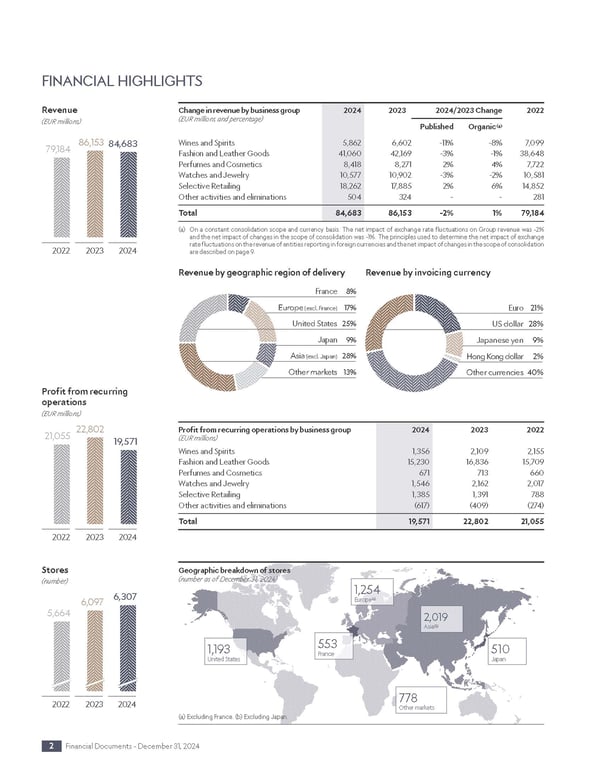
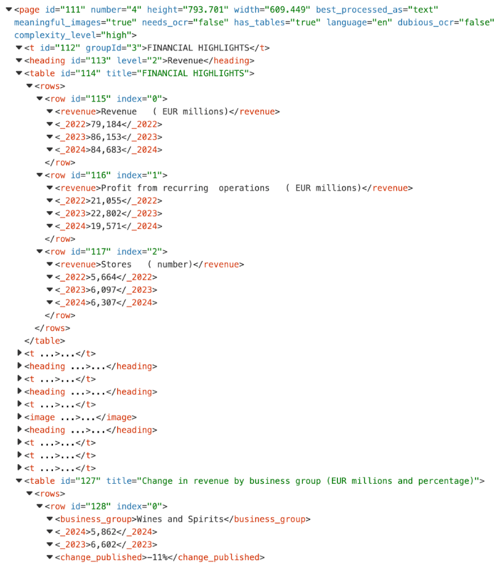
Original document
LVMH-Financial-Highlights

->

Vertesia-Semantic-LVMH-Results

# FINANCIAL HIGHLIGHTS 

## Revenue

(EUR millions)
![img-0.jpeg](img-0.jpeg)

2022
2023

## Profit from recurring operations

(EUR millions)
![img-1.jpeg](img-1.jpeg)

2022
2023

| Change in revenue by business group <br> (EUR millions and percentages) | 2024 | 2023 | 2024/2023 Change |  | 2022 |
| :--: | :--: | :--: | :--: | :--: | :--: |
|  |  |  | Published | Organic (a) |  |
| Wines and Spirits | 5,862 | 6,602 | $-11 \%$ | $-8 \%$ | 7,099 |
| Fashion and Leather Goods | 41,060 | 42,169 | $-3 \%$ | $-1 \%$ | 38,648 |
| Perfumes and Cosmetics | 8,418 | 8,271 | $2 \%$ | $4 \%$ | 7,722 |
| Watches and Jewelry | 10,577 | 10,902 | $-3 \%$ | $-2 \%$ | 10,581 |
| Selective Retailing | 18,262 | 17,885 | $2 \%$ | $6 \%$ | 14,852 |
| Other activities and eliminations | 504 | 324 | - | - | 281 |
| Total | 84,683 | 86,153 | $-2 \%$ | 1\% | 79,184 |

(a) On a constant consolidation scope and currency basis. The net impact of exchange rate fluctuations on Group revenue was -2\% and the net impact of changes in the scope of consolidation was $-1 \%$. The principles used to determine the net impact of exchange rate fluctuations on the revenue of entities reporting in foreign currencies and 

FINANCIAL HIGHLIGHTS
Revenue
Change in revenue by business group
2024
2023
2024/2023 Change
2022
(EUR millions)
(EUR millions and percentage)
Published
Organic
(a)
86,153 84,683
Wines and Spirits
5,862
6,602
-11%
-8%
7,099
79,184
Fashion and Leather Goods
41,060
42,169
-3%
-1%
38,648
Perfumes and Cosmetics
8,418
8,271
2%
4%
7,722
Watches and Jewelry
10,577

AGENTIC SEARCH

Get answers, not just search results

Traditional search gives you a list of documents and you have to find the answer yourself. That doesn't scale, and it doesn't help your AI agents work efficiently. Vertesia's agentic search does the reading for you. Ask a question. Get a real answer, with the exact sources behind it.

multi-mode-search
Multi-mode search

Search across millions of documents using semantic search (similar meaning), full-text search (exact phrases), and structured metadata search (exact field) in one query.

authentication
Permission-aware retrieval

Access controls are enforced at retrieval, not just at the folder level. Users and agents only see content they are authorized to access.

learning-icon
Historical content access

Older documents are indexed and retrieved the same way as new ones. Institutional knowledge from years ago is just as findable as content created today.

progress
Explainable results

Every result includes a source trace so agents can cite the exact document, section, and page behind each answer.

CONTENT INTELLIGENCE AT SCALE

Gain insights across your content history

Document preparation and agentic search are necessary but the real power of content intelligence is what you can learn from across your content history. Vertesia's agents can read thousands of documents at a time and surface insights that no person could find on their own.

semantic-grouping

Compare new content to past content, automatically

forecast

Surface trends and outliers across repositories

transparency

Find similar past situations to inform current decisions

FAQ

Frequently asked questions about content intelligence

What is content intelligence?

Content intelligence is Vertesia's foundational platform capability that prepares enterprise content for AI. It automatically transforms raw documents, images, audio, and video into clean, structured, AI-ready material at the point of intake. It covers the full lifecycle: how content is prepared, enriched, indexed, governed, and retrieved. It works beneath RAG, agents, and every AI-powered workflow on the platform.

What's the difference between document intelligence and content intelligence?

Document intelligence focuses on extracting data from individual documents: reading a contract, pulling fields from a form, classifying a single file. It treats each document as its own task.

Content intelligence goes further. It treats your entire content ecosystem (documents, images, audio, video, and data across all your systems) as a single, connected knowledge base that AI can access, understand, and act on. Where document intelligence processes one file at a time, content intelligence manages the full lifecycle at scale: intake, enrichment, indexing, retrieval, governance, and insight generation across your whole content estate.

Think of it this way: document intelligence reads a document. Content intelligence makes every document in your organization work for AI, including the ones created years before you deployed AI.

Vertesia delivers both. Semantic DocPrep handles document-level preparation. The broader content intelligence platform handles everything that happens before and after, from intake to retrieval to organizational insights.

Why can't AI read my documents as-is?

AI models can read text, but they struggle with structure. When a PDF is converted to plain text, it loses the layout, tables, headings, and relationships that carry most of its meaning. That leads to hallucinations, missed context, and poor AI performance. Vertesia preserves that structure through Semantic Document Preparation before the content ever reaches a model.

What is Semantic DocPrep?

Semantic Document Preparation (Semantic DocPrep) is Vertesia's patent-pending document preparation technology. It preserves tables, clauses, section hierarchies, and attachments so AI agents can read and reason over content accurately, not just display it for humans.

What content types does Vertesia support?

Vertesia supports PDFs, Microsoft Word, PowerPoint, Excel, scanned forms, images, audio files, and video. Audio and video are converted to timestamped transcripts with speaker labels, making them fully searchable and usable by AI agents.

How does Vertesia solve the findability problem?

Vertesia builds three types of indexes for every piece of content: a vector (semantic) index, a structured field index, and a full-text index. When an AI agent asks a question, it searches all three at once. This hybrid retrieval approach returns precise, relevant answers, not a long list of loosely related documents to manually sort through.

What is agentic RAG?

Agentic RAG (Retrieval-Augmented Generation) grounds AI responses in your actual documents rather than general training data. Vertesia combines semantic, full-text, and structured search in one query, with permission enforcement built in at retrieval time.

Does Vertesia work on existing repository content?

Yes. Vertesia can process and enrich historical content that predates your AI deployment. Existing documents can be run through the content intelligence pipeline to extract metadata, generate summaries, create embeddings, and add semantic structure without migrating or replacing your current systems.

Is content governance built-in?

Absolutely. Permissions, lineage, redaction, and retention policies are enforced at intake and at every retrieval query. Content is governed throughout its full lifecycle on the Vertesia platform, meeting the requirements of regulated industries including financial services, healthcare, and legal.