The AI problem every IT leader recognizes
Your AI pilot worked beautifully. The demo impressed executives. The proof-of-concept showed real promise. Leadership approved the budget.
Six months later, it's still not in production.
If this sounds familiar, you're not alone. According to new research from DZone, 70-95% of AI pilots never reach production. And the companies struggling with this aren't small startups or tech novices. They're established enterprises with skilled teams, solid infrastructure, and clear business cases.
So what's going wrong?
The AI maturity gap is real and it's expensive
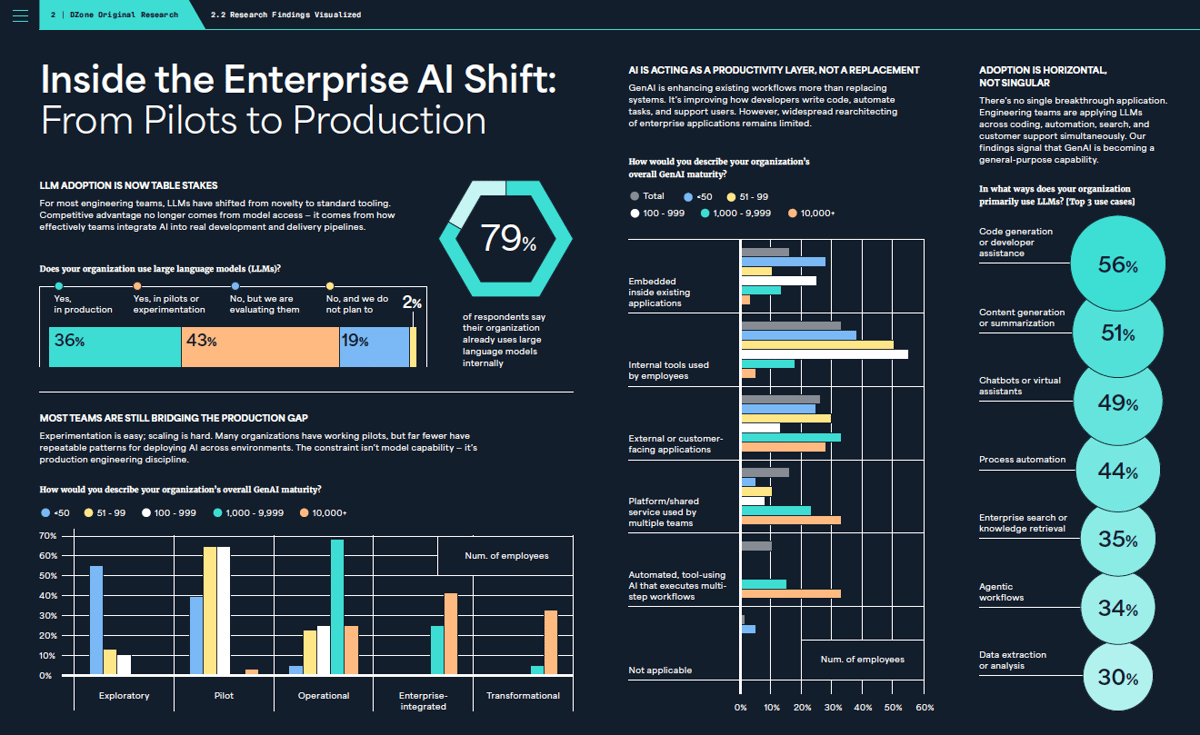
DZone's 2026 Generative AI Survey reveals a striking pattern. While 79% of organizations now use large language models, only 22% have achieved what researchers call "enterprise-integrated or transformational maturity."
That's a 57-point gap between adoption and actual value.
The rest (64% of organizations) remain stuck in pilot or early operational phases. They're trapped in what the research calls "the uncanny valley between experimentation and operational maturity." Their AI systems work in demos but fail under real-world conditions. Their pilots show promise but never scale. Their teams build impressive prototypes that never ship.
The cost? Millions in wasted resources, frustrated teams, and missed opportunities while competitors pull ahead.
The constraint isn't what you think
Here's the surprising finding: the gap between pilot and production isn't a technology problem.
It's not about model performance. Nearly every organization has access to the same powerful models from OpenAI, Anthropic, Google, and others. Model capability isn't the bottleneck anymore.
It's not about AI expertise either. Most large enterprises have hired data scientists, AI engineers, and ML specialists. Technical talent isn't the limiting factor.
The real constraint? Architectural discipline.
The research shows that successful AI deployments require the same engineering rigor that transformed software delivery over the past decade. Just as DevOps turned deployment chaos into competitive advantage, what researchers now call "LLMOps" is becoming the defining factor in AI success.
The teams reaching production aren't using better models. They're using better architecture.
What separates the 22% who succeed
The research reveals clear patterns among organizations that successfully move AI from pilots to production. Here's what they do differently:
1. They treat AI as infrastructure, not features
Failed pilots often start as isolated experiments. A team builds a chatbot here, an automation there, a content generator somewhere else. Each works in isolation, but nothing connects or scales.
Successful organizations take a different approach. They consider AI as shared infrastructure with centralized retrieval layers, evaluation pipelines, and governance frameworks. Instead of 50 teams building 50 separate systems, they use a platform that all teams can build on.
The difference? One approach creates technical debt and fragmentation. The other creates compounding capability.
2. They've moved beyond "shadow AI"
Here's a pattern many IT leaders will recognize: Teams frustrated by slow approval processes start using AI tools without formal authorization. They connect ChatGPT to sensitive data. They build critical workflows on personal accounts. They create compliance nightmares trying to move fast.
The research shows that organizations with clear AI governance actually report 68% faster time-to-market than those without it.
That's not a typo. Governance accelerates rather than blocks progress.
How? By making compliant approaches easier to follow than circumventing them. By eliminating approval bottlenecks with clear frameworks. By preventing the compliance delays that kill projects later.
3. They ground AI in trusted data
One of the most telling statistics from the research: 69% of organizations have implemented Retrieval-Augmented Generation (RAG).
RAG isn't experimental anymore. It's become table stakes for production AI.
Why? Because grounding models in your own trusted data sources solves multiple problems at once. It reduces hallucinations. It enables systems to work with current information. It creates audit trails. It makes AI outputs trustworthy enough for business-critical decisions.
The research shows that 75% of organizations now use vector databases, the infrastructure that makes RAG possible. Among larger enterprises, adoption is even higher. This technology stack is solidifying into standard practice.
4. They design for failure
Production systems fail. Networks go down. APIs time out. Models produce unexpected outputs. This isn't pessimism, it's reality.
Successful AI implementations plan for these failures with what the research calls "fallback ladders":
- Clarify: Ask the user for more information
- Degrade: Switch to a simpler model or rule-based approach
- Alternate: Try a different strategy
- Handoff: Escalate to a human
Organizations stuck in pilot phase often build systems that work perfectly or fail completely. There's no middle ground. Production systems need graceful degradation, not binary outcomes.
5. They roll out in stages
The research reveals a clear pattern for successful deployments:
Phase 1: Internal dogfooding - Teams use the system themselves first
Phase 2: Canary release - 5-10% of users get access
Phase 3: Expanded rollout - 25-40% of users
Phase 4: General availability - Full deployment with kill switches ready
Organizations that try to go straight from pilot to full production often fail. Those that stage their rollouts catch problems early when they're easier to fix.
The business case is clear
Organizations that successfully operationalize AI report tangible benefits:
- 68% see faster time-to-market
- 62% reduce manual work
- 61% increase developer productivity
- 59% improve access to knowledge
- 51% deliver better customer experience
These aren't visionary claims about AI reshaping strategy. These are pragmatic, measurable gains happening right now. AI is accelerating execution before it reshapes business models.
And here's the key: these benefits compound over time. A 60% productivity gain doesn't just make teams faster, it lets them tackle problems they couldn't before. It changes what's possible.
5 takeaways for IT leaders
Based on the research findings, here are the most important actions IT leaders should take:
-
Stop building point solutions, use a platform
Move from team-level experiments to organization-level infrastructure. Create shared retrieval layers, evaluation pipelines, and governance frameworks that all teams can use.
-
Make governance practical, not painful
Design security and compliance approaches that are easier to follow than circumvent. Clear frameworks with fast approvals beat restrictive policies that teams work around.
-
Implement structured evaluation
Don't hope AI outputs are good. Test them. Create "golden" datasets that represent real use cases. Build pipelines that catch quality issues, bias, and drift before users do.
-
Design fallback systems
Every AI feature needs a plan for when it fails. Build clarification prompts, degraded modes, alternative approaches, and human escalation paths.
-
Ship with staged releases
Internal testing → small user group → expanded rollout → full deployment. This pattern catches problems when they're easy to fix, not after they've impacted thousands of users.
The bottom line
AI adoption is mainstream. Nearly 80% of organizations are using it. The question is no longer "Should we use AI?" but "How do we make AI actually work at scale?"
The answer isn't better models or more AI talent. It's better engineering discipline.
The research makes this clear: success comes from treating AI as mission-critical infrastructure, building with governance and fallbacks from day one, and bringing the same operational rigor to AI that transformed software delivery over the past decade.
The teams winning today aren't the ones experimenting fastest. They're the ones operationalizing best.
Get the full research
This blog covers just a fraction of the findings from DZone's 2026 Generative AI Survey. The full report includes:
- Detailed adoption metrics across RAG, vector databases, and LLMOps practices
- Architectural patterns for retrieval pipelines, evaluation frameworks, and governance models
- Implementation frameworks for staged rollouts and cross-functional teams
- Expert insights from Microsoft, Capital One, and leading AI practitioners
- Practical checklists for contracts, observability, and incident response
Download the complete report here →
Whether you're just starting your AI journey or trying to move pilots into production, this research provides a roadmap based on what's actually working for enterprise IT teams today.