PRODUCT
Building Reliable Enterprise AI: Why the Model Is Only Half the Battle
Explore the crucial role of infrastructure in enterprise AI.
Unlock the potential of your AI initiatives by prioritizing content preparation. Discover how proper data structuring can drive successful AI outcomes.
Most enterprise AI initiatives fail not because of the model, but because of the fuel. While organizations spend millions on LLMs, their internal content remains unstructured and "unreadable" for machines.
Key takeaways:
Most organizations are fueling their AI initiatives with the wrong octane.
They’re spending millions on cutting-edge LLMs, hiring data science teams, and racing to deploy generative AI solutions. But here’s the truth: if your content isn’t prepared for AI, you’re essentially pouring watered-down fuel into a best-in-class engine.
The result? Stalled projects, wasted resources, and AI outputs that range from mediocre to downright dangerous.
I’ve spent the past year working with enterprises navigating AI adoption, and I’ve identified a pattern that separates the winners from the experimenters: the quality of your AI outputs is determined long before you prompt your first model. Your content—the necessary fuel powering these systems—must be structured, enriched, and optimized for machine consumption.
Without this preparation, you’re not just limiting AI’s potential; you’re amplifying your existing content problems at scale.
You’ve heard “garbage in, garbage out” a thousand times. But with AI, the stakes are exponentially higher.
You could have all of your content, data, and company documentation in a perfect state for human consumption. But if AI can’t make meaningful use of that content, transforming your organization with AI becomes next to impossible.
Here’s why: context is everything when it comes to making generative AI models behave in consistent and accurate ways. These models don’t actually “know” anything. They work by predicting the next token (think of a “token” as roughly a “word”). While this allows these models to perform amazing feats, they’re prone to the dreaded hallucination when dealing with subjects where they lack expertise.
Let me give you a concrete example. Ask a typical AI model about your company’s internal HR policies, and it will make stuff up. It will hallucinate because it doesn’t have that information.
However, pass that same model your HR policy at runtime as context and ask the same question, and you’ll see dramatically better results. This is retrieval augmented generation (RAG) in action.
But here’s the challenge: content can’t just be passed to a model as-is. It needs to be prepared properly.
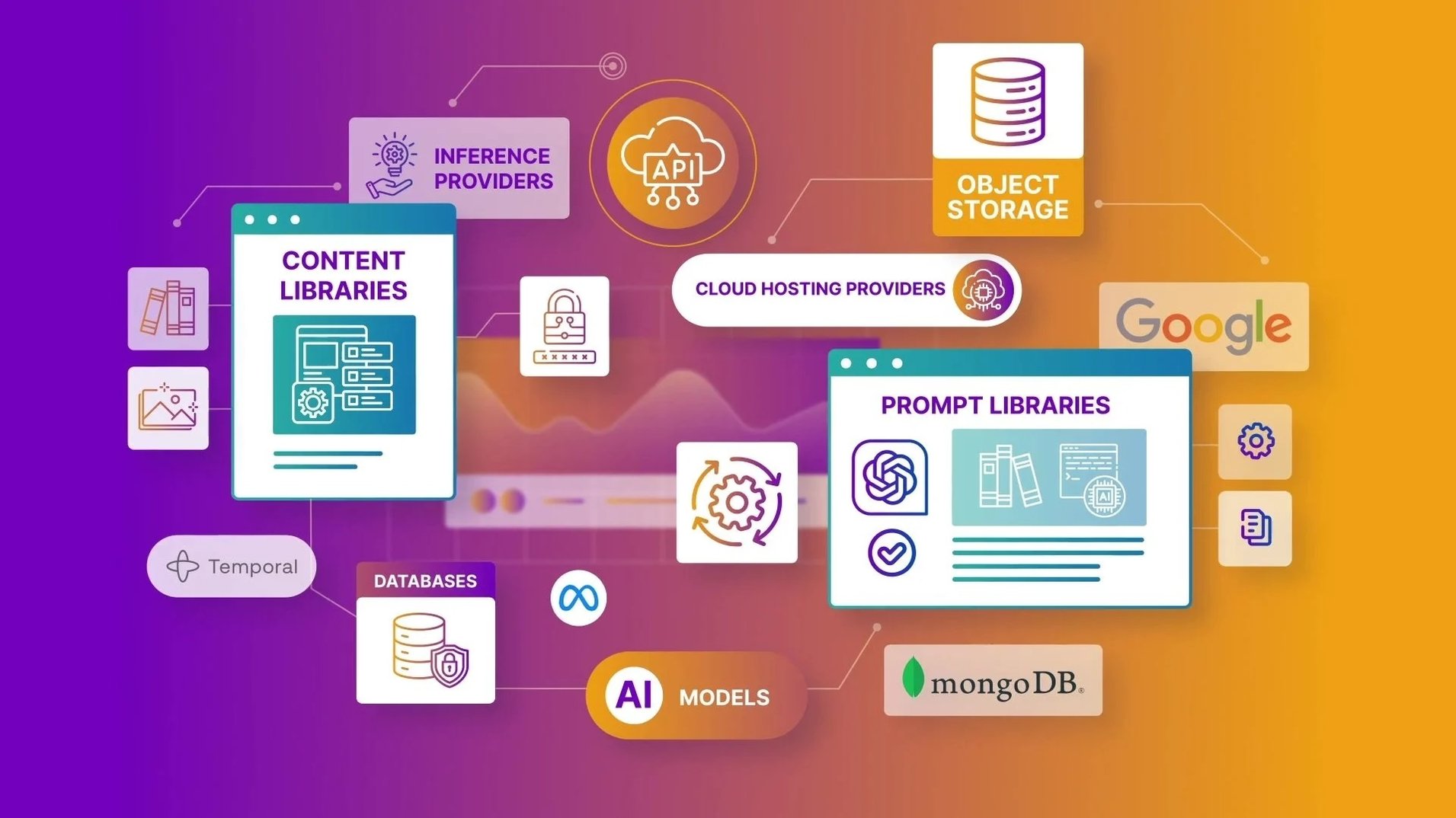
The complexity of content preparation is why Vertesia holds several patents specific to this problem. It’s not a simple matter of uploading files to a vector database and calling it done.
Enterprise documents are complex. They’re detailed and lengthy. They contain images, headers, sub-headers, tables, and footnotes—all of which relate to one another in meaningful ways. The better models can understand this context and these relationships, the better the results will be.
Without proper preparation, there’s a very real risk of hallucination. If the context models needed were a simple sentence or paragraph, this wouldn’t be difficult. But that’s not the reality of enterprise content. Your critical business documents have:
All of this must be preserved, enriched, and made accessible to AI systems. Miss any of it, and you’re feeding your AI incomplete information—which leads directly to incomplete, inaccurate, or hallucinated outputs.
The consequences of inadequate content preparation aren’t subtle. They’re expensive, time-consuming, and often fatal to AI initiatives.
Extended timelines: Organizations spend 3-6 months just preparing data for a single custom AI solution, then another 3-6 months building and deploying it. That’s 6-12 months before you see any value—if the project survives at all. Meanwhile, your competitors are already extracting insights from the same types of content you possess.
Project failure: Over 80-90% of Gen AI projects get halted or fail entirely. Most organizations haven’t progressed beyond experimentation. While there are many contributing factors, inadequate content preparation is a primary culprit. You can’t build a production AI system on a foundation of poorly prepared content any more than you can build a skyscraper on unstable ground.
Hallucinations and inaccuracy: When AI systems work with poorly prepared content, they generate unreliable outputs. Users lose confidence. Stakeholders pull funding. Your AI initiative becomes another cautionary tale in the “AI didn’t work for us” narrative.
The insidious part? Early experiments often look promising. You test with simple queries on well-structured documents and get great results. But when you scale to real-world complexity—messy PDFs, scanned documents with handwritten notes, multi-format engineering specs—the system falls apart.
This is where Vertesia’s approach fundamentally differs from traditional content management and bolt-on AI solutions.
We built our platform specifically to solve the content preparation problem. Our patented Semantic DocPrep technology automates the transformation of unstructured content into AI-ready fuel—handling everything from complex engineering specs to messy PDFs with handwritten notes.
This isn’t about moving your content into yet another repository. It’s about adding an intelligent orchestration layer across all your existing systems.
Here’s what that means in practice:
If you’re a CTO or CIO evaluating AI initiatives, here’s my advice: stop treating content preparation as an afterthought. It’s not a prerequisite to AI adoption; it’s the foundation.
The organizations moving from experimentation to production all share one characteristic: they recognized that content quality determines AI quality. They’re deploying AI with confidence because they know their content can support it. They’re seeing the returns others only projected in their business cases.
This means:
The question isn’t whether AI will transform your business. The question is whether your content is ready to fuel that transformation.
Organizations that recognize this pattern—that content preparation is the foundation, not an afterthought—are the ones moving confidently into production. They’re deploying AI that works because the fuel is right.
Explore the crucial role of infrastructure in enterprise AI.
CISOs explore securing AI innovations, addressing shadow AI, data exfiltration, and design strategies for safe deployment without stifling progress.
Documentation generation and maintenance is a good use case for LLM-powered tasks when paired with a platform a approach.