
AGENTIC AI FOR ECM
Why AI-native content platforms are replacing legacy ECM
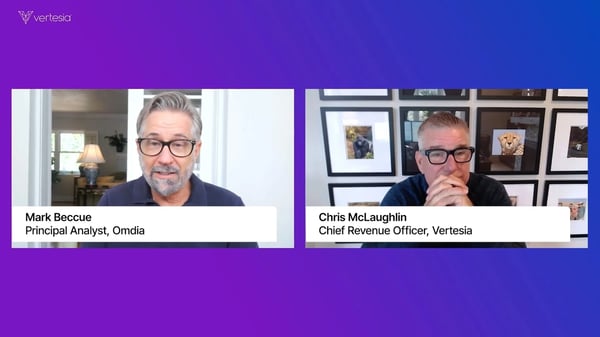
In this on-demand fireside chat, Omdia Principal Analyst, Mark Beccue, and Vertesia's Chris McLaughlin, reveal why AI-native content platforms are replacing legacy ECM systems and why the business case is stronger than you might expect.
Why legacy ECM systems are holding you back
Most enterprise content management systems were built 15 to 30 years ago. Their underlying architectures are outdated. Their operating costs are high. And they are simply not designed for a world powered by AI. Here is what that means for your organization right now:
The costs keep going up
Large legacy ECM systems cost millions of dollars per year. Even smaller systems can run hundreds of thousands of dollars annually when you add up licensing, storage, database, index, compute, and infrastructure. Many of these systems are "always on," burning resources around the clock.
ECM vendors struggle to add AI capabilities
ECM vendors treat AI as a bolt-on feature, not a core capability. That means you get surface-level AI tools that can't deliver the outcomes your business needs. These systems were never designed to make your content AI-ready.
Migrating from one legacy system to another isn't the answer
A large ECM migration between two traditional systems can take 12 to 18 months and cost millions of dollars. The result? You end up with a slightly newer version of the same problem. As one expert put it: "It's like trading one fax machine for another."

Discover why your legacy ECM is costing you more than you think
Explore why forward-thinking enterprises are moving to AI-native content platforms and cutting costs in half in the process.
This fireside chat is built for senior decision-makers who need clear answers, not technical deep-dives. Here is what you will walk away with:
- The real cost of your legacy ECM including the hidden costs most organizations overlook
- Why ECM-to-ECM migrations fail and why the traditional approach traps organizations in a cycle of rising costs
- How AI-native platforms work and what makes them fundamentally different from legacy systems
- The build vs. buy decision the honest case for why building your own AI content solution rarely makes financial sense
- Migration timelines and ROI how large enterprises are migrating millions of documents in months and achieving payback in under 12 months
- Real-world data from Omdia research including survey insights on AI agent adoption, enterprise expectations, and content management trends
Meet the experts
Mark Beccue
Principal Analyst of AI, Omdia
Mark leads AI research at Omdia, one of the world's leading technology research and advisory firms. He brings deep expertise in enterprise AI adoption, agentic AI use cases, and how organizations are navigating the shift from legacy technology to AI-powered platforms.

Chris McLaughlin
CRO, Vertesia
Chris has spent more than 30 years in the enterprise content management industry. He has held senior leadership roles at FileNet, EMC Documentum, and Hyland. He served as Chief Product Officer at Nuxeo, the same team that built Vertesia. With that depth of experience, Chris brings a rare combination of product expertise, customer insight, and hard-won lessons from decades of ECM migrations.
What makes an AI-native content platform different
An AI-native content platform is not a newer version of your old ECM. It is a fundamentally different approach built from the ground up to work with AI.
Modern architecture, built for today

AI is built in, not bolted on

Flexible model selection

The ROI of moving to an AI-native content platform
AI ROI is under a microscope in every boardroom right now. Here is the financial picture for ECM migration to an AI-native platform:
Migration cost is lower than you expect
For large systems with billions of documents, Vertesia typically completes migrations in 4 to 6 months. For smaller systems, migration can take just weeks. Compare that to 12 to 18 months for a traditional ECM-to-ECM migration.
Operating costs drop significantly
Organizations that migrate to an AI-native platform typically cut their combined operating, infrastructure, and subscription costs by 50% or more. If you are currently running ECM in a vendor's cloud, the savings are even greater.

Payback is often under 6 months
Because migration costs are low and savings are immediate, the payback period is typically less than a year. In many cases, organizations see positive ROI in under 6 months. That means the savings can then fund strategic AI initiatives rather than being absorbed by ECM overhead.
Your content becomes a competitive asset
Once your content is AI-ready, you can deploy AI agents and applications on top of it. Instead of spending budget on ECM maintenance, your team can focus on building AI-powered workflows, automating manual tasks, and gaining insights from your content at scale.
Should you build your own AI content solution?
Many IT leaders explore building their own AI content management solution. It sounds appealing, full control, custom-built, AI-first. But the math tells a different story.
Building the core components of a modern ECM system (storage, database, indexing, monitoring, access control, search, and security) takes about 9 months and roughly $1-2M in development costs. That gets you the basics.
To match the AI-native capabilities of a purpose-built platform, including agentic workflows, intelligent content preparation, and enterprise-scale document processing, you are looking at 3+ years of additional development and millions more in investment.
And once it's built, you own it. That means ongoing engineering resources for bug fixes, new features, performance improvements, and security patches. You have all the problems of running a software company without that being your core business.
Omdia research reinforces this concern:
62%
62% of organizations say they lack the in-house expertise to build their own AI agent solution
81%
81% say building their own AI agent solution involves higher risk and complexity
The better question
What could your team accomplish if they were building AI apps and workflows with a proven platform instead of building the platform itself?
Frequently asked questions
What is an AI-native content platform?
An AI-native content platform is similar to an enterprise content management system, but it was built from the ground up to work with artificial intelligence. Unlike traditional ECM systems that add AI as a feature, AI-native platforms make every piece of content automatically ready for AI processing. This includes turning complex documents, tables, and images into structured data that large language models (LLMs) can accurately read and use.
How is an AI-native content platform different from a traditional ECM?
Traditional ECM systems were built 15 to 30 years ago. Their architectures are outdated, their costs are high, and they were not designed for AI. AI-native platforms use modern, serverless architectures that scale on demand, cost far less to operate, and are engineered so AI is a core capability not an add-on. They also offer flexible model and cloud choices, so organizations are not locked into a single provider.
Why are enterprises replacing their legacy ECM systems?
Three main reasons drive ECM replacement. First, 88% of enterprises run more than one ECM system, creating cost duplication and data silos. Second, legacy systems are expensive to maintain, running into the hundreds of thousands or millions of dollars per year. Third, AI has created a turning point: organizations need their content to power AI agents and workflows, and legacy ECM systems simply cannot deliver that.
How long does it take to migrate from a legacy ECM to an AI-native platform?
For large systems managing billions of documents, migration typically takes 4 to 6 months. Smaller systems can be migrated in just weeks. This is significantly faster than traditional ECM-to-ECM migrations, which can take 12 to 18 months.
What is the ROI of migrating to an AI-native content platform?
Organizations that migrate to an AI-native platform typically cut their operating, infrastructure, and subscription costs by 50% or more. Because migration costs are low and savings begin immediately, payback is typically achieved in under 12 months, and often in less than 6 months.
Why do ECM migrations fail?
Traditional ECM migrations fail for two main reasons. First, organizations trade one outdated system for another, gaining little real improvement. Second, the cost and complexity of migration (often $1 to $2 million and 12 to 18 months) makes the ROI too thin or too far in the future. Many organizations give up and stay on their existing system, even as costs rise.
Is it better to build or buy an AI content management platform?
For most enterprises, buying a purpose-built AI-native platform is the better choice. Building a basic ECM from scratch takes about 9 months and $1 to $2 million. Reaching the full AI-native capability of a mature platform takes 3 or more additional years. That is time and money that most organizations are better off investing in building AI applications and workflows, not the underlying infrastructure.
What is content preparation for AI, and why does it matter?
Content preparation means transforming documents into a format that AI can accurately understand. Most LLMs struggle with tables, charts, graphics, and complex PDF layouts. They lose important relationships between data points. AI-native platforms solve this problem at the foundation, ensuring that every document is structured, tagged, and ready for AI before it is ever accessed by an AI agent or application. Without proper content preparation, AI models are more likely to produce inaccurate results, also known as hallucinations.
Who is Vertesia?
Vertesia is an AI-native content platform built by ECM experts. The company was founded to solve the core challenge of agentic AI: making enterprise content truly AI-ready at scale. Vertesia enables organizations to migrate from legacy ECM systems quickly and cost-effectively, and to build AI agents and applications on top of a modern content foundation.