Ver-: Rooted in the Latin "veritas," meaning "truth," "Ver-" emphasizes our dedication to integrity, transparency, and trustworthiness. This foundation of truth underscores Vertesia’s reliability in providing a secure, dependable platform.
-tesia: Inspired by terms like "tensor" and "Cartesian," "-tesia" evokes the essence of advanced, structured technology and thoughtful design. It suggests a methodical, innovative approach, that simplifies and enhances complex processes.
What does Vertesia mean?
Vertesia is a name that embodies our future-focused mission, reflecting our commitment to AI-led business transformation with technology that is both intuitive and impactful.
Vertesia conveys the idea of insight and authenticity, guiding users through complexity to uncover valuable understanding. Refined and professional, Vertesia represents a commitment to discovery, intelligence, and powerful yet accessible technology that enables organizations to thrive in an AI-driven world.
LOGOS
The Vertesia logo
The full-color horizontal logo (standard) must be used in all situations where a horizontal logo format is allowed on a white or light colored background. The Vertesia wordmark has been trademarked. All logos using the wordmark must have the trademark (TM) symbol. When the logo is placed on a dark background, use the "all-white" version of the logo.
Do not modify the logo in any way, including but not limited to rotation, color, shape, font style, or spacing.
Do not place the logo on background colors or images that compromise readability.
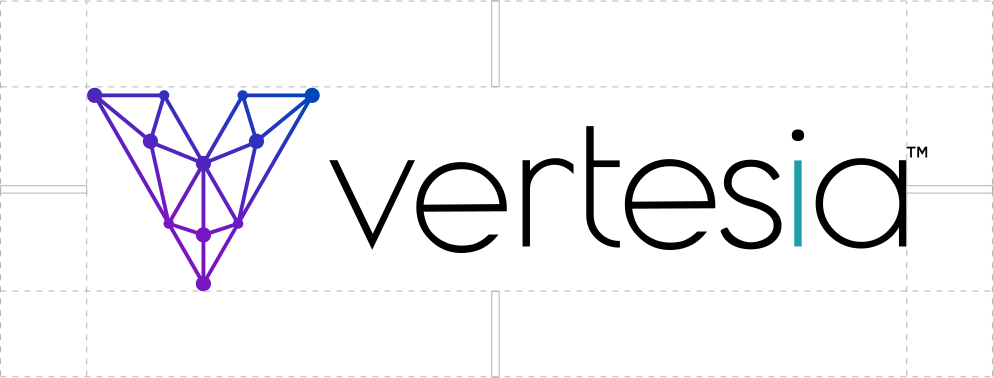
Safe zone
The Vertesia logo should always be clearly visible. Keep the logo separated from other visual elements by a distance equal to the height of the "i" on all sides, not including the dot above the "i". This distance is considered the minimum uninterrupted space surrounding the logo. We call it the safe zone, or clear space, and it should be adhered to in most situations.
The "stacked" Vertesia logo
The "stacked" logo may be used in situations where a horizontal logo format is not allowed and the brandmark alone is insufficient.
Do not modify the logo in any way, including but not limited to rotation, color, shape, font style, or spacing.
Do not place the logo on background colors or images that compromise readability.
BRANDMARK
The Vertesia brand mark
This is the unique and modern brand mark which represents Vertesia. It can be used to identify Vertesia when accompanied by the company name (ex: LinkedIn company profile) and as the Favicon for the Vertesia website.
Do not modify the brand mark in any way, including but not limited to rotation, color, shape, font style, or spacing.
Do not place the brand mark on background colors or images that compromise readability.
COLORS
Vertesia colors
Be mindful of which colors you use to represent the brand.
Limit the number of colors on one slide or page to no more than 3 when possible.
Too many colors in close proximity can appear chaotic and unprofessional.
Do NOT use colors outside of this color palette in slides, web pages or other marketing collateral.
Primary Vertesia colors
Vertesia Blue (PANTONE® 2728 C) Trust | Competence | Loyalty
HEX #0047BB RGB 0,71,187 CMYK 100,62,0,27
75% HEX #406EC2
50% HEX #8AA9DE
25% HEX #C6D4EF
10% HEX #E8EDF9
Pantone 2728C (Vertesia Blue) is used to emphasize important text and hyperlinks. It is also used as the background/outline color for buttons on the website.
Black Formal | Sophisticated | Security
HEX #000000 RGB 0,0,0 CMYK 50,50,60,100
Black is the primary font-color.
White Clean | Simple | Honest
HEX #FFFFFF RGB 255,255,255 CMYK 0,0,0,0
White is the primary background color.
Secondary Vertesia colors
Light Blue (PANTONE® 11-0700 TCX Lucent White)
HEX #E8EDF9 RGB 232,237,249 CMYK 4,2,0,0
Light Blue is used as a background color to distinguish sections on web pages, slides, and other collateral as needed. Only black or blue text should be placed on the Light Blue background.
Purple (PANTONE® 19-3438 TCX Bright Violet)
HEX #7815C2 RGB 120,21,194 CMYK 55,95,0,0
75% HEX #9A4FD1
50% HEX #BE95E1
25% HEX #DFCCF1
10% HEX #F0E7F7
Purple can be used as a secondary color when Vertesia Blue has already been used. It can occasionally be used as a font color, but only in a semi-bold font style.
Accent colors
Teal (PANTONE® 2228 C)
HEX #1E9EA6 RGB 130,158,166 CMYK 100,8,27,0
75% HEX #56B6BC
50% HEX #8ECFD3
25% HEX #C7E7E9
10% HEX #E8F4F5
Teal can be used as an accent color to accompany Vertesia Blue and purple.
Orange (PANTONE® P 17-8 C)
HEX #F69E0C RGB 246,158,12 CMYK 0,36,89,2
75% HEX #F8B648
50% HEX #FACF9A
25% HEX #FDE7CE
10% HEX #FEF4E9
Orange should be used sparingly, only for small accents and "challenges".
Gradients
Gradients can be used to help create visual interest and draw the eye in to important elements. The primary gradient is Purple-Blue. This is the same color gradient used in the Vertesia logo brandmark.
Purple-Blue (primary gradient)
Teal-Blue (secondary gradient)
Orange-Purple (tertiary gradient)
TYPOGRAPHY
Font style
Inter Tight font family is used to clearly and objectively communicate information. Inter Tight is a specialized version of Inter with tighter spacing. It is licensed under the Open Font License and can be used in products and projects – print or digital, commercial or otherwise. If Inter Tight is unavailable, please use Arial.
Use Light for all paragraph copy in slides and collateral
Use Normal/Regular for all website copy
Use Semi Bold for emphasis
CAPITALIZATION
Use sentence case for H1-H6 headings, body copy, and bullets. (Sentence case is where only the first letter of the sentence is capitalized.)
UPPERCASE should be used for small headings.
FONT COLORS
Black is the preferred font color on white and light-colored backgrounds.
White font color is used on black, dark-colored, and dark gradient backgrounds.
Accessibility should always be considered. When in doubt, reference a contrast checker.
IMAGES
Branded photographs
Vertesia branded imagery contains diverse individuals in everyday moments. Photos should feel authentic and highlight the use of technology. A Blue-Purple gradient is applied to images for a consistent brand experience. When targeting a specific audience or industry, utilize photos that resonate with the audience. If you need a higher resolution version of an image, please email: contact@vertesiahq.com with your request.
ICONS
Iconography
Vertesia icons are vector-based images that help to visually represent a concept or idea. These icons are either black or white, depending on the background color, and use an "outline" shape. Do not place icons on background colors or images that compromise legibility. When choosing an icon, be sure it complements or corresponds to the accompanying text.